

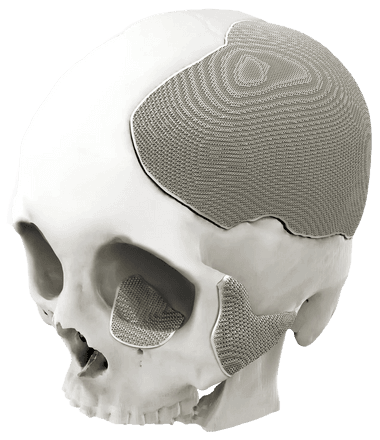
Cranial implant
Fills defects in the cranial vault, perforated to encourage tissue re-integration.
Patient-specific PEEK implants · Tunis, since 2020
We design and 3D-print PEEK implants from your patient's CT scan — shaped for their anatomy, and for theirs alone.
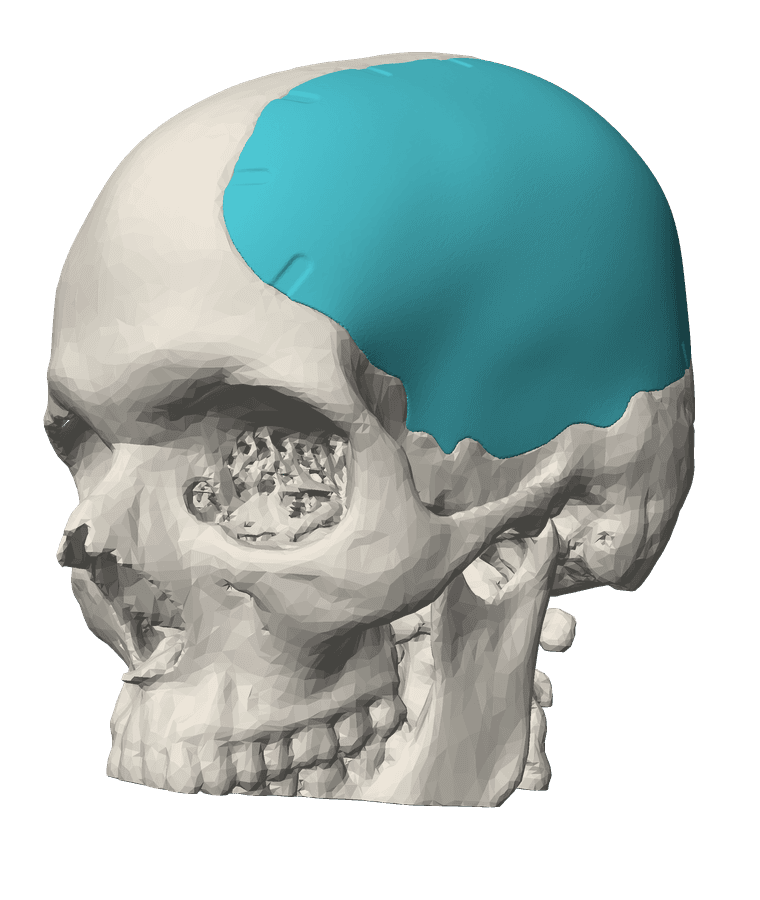
After trauma or a tumour resection, a void is left in the bone. Traditional reconstruction forces the surgeon to shape the piece in theatre, at length, without ever quite recovering the form that was lost.
COVTECH MEDICAL was founded in 2020 in Le Bardo to remove that step. We start from the patient's scan, rebuild their anatomy in 3D, and manufacture the missing piece — biocompatible, lightweight, and already the right shape when it reaches the operating room.
The implant arrives ready. The surgeon operates; they don't sculpt.
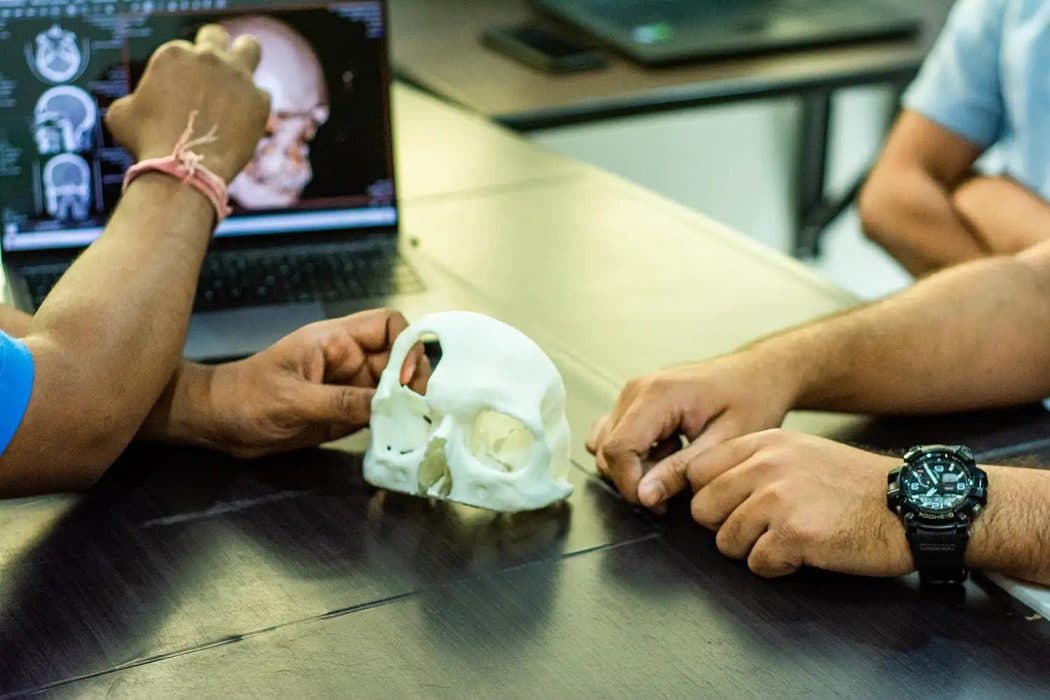
Nothing is printed until the prescribing surgeon has approved the design.
You send us the patient's CT slices in DICOM format. We segment them and reconstruct the anatomy into a workable 3D model.
We analyse the bone defect with you: volume to fill, available fixation points, constraints of the surgical approach.
The implant is drawn onto the patient's own morphology. Depending on the volume being replaced, it may be designed as one piece or several.
A physical plastic prototype is printed — something to handle and offer up against the bone model before any final production.
You sign off on geometry, thickness and fixation points. Until you do, nothing goes into production.
The final implant is manufactured in PEEK-OPTIMA™ Natural and delivered non-sterile, ready for sterilisation by your facility.
Polyetheretherketone is an implantable polymer whose elastic modulus sits close to that of cortical bone. A PEEK implant follows the internal movement of the bone instead of fighting it.
What the choice of material changes — for the patient as much as for the surgeon.
Steel remains cheaper, but its thermal swings and radiation scatter weigh on the patient's daily life and on treatment dosing — in radiotherapy above all.
Elasticity vs cortical bone
CT and MRI
Thermal behaviour
Corrosion
Intraoperative adjustment
Weight
| Criterion | PEEK | Titanium | Stainless steel |
|---|---|---|---|
| Elasticity vs cortical bone | Close | Markedly stiffer | Markedly stiffer |
| CT and MRI | Radiolucent, minimal artefact | Pronounced artefacts | Scatters radiation |
| Thermal behaviour | Insulating | Conductive | Conductive, sensitive to change |
| Corrosion | Inert | Very good resistance | Weaker resistance |
| Intraoperative adjustment | Millable | Difficult | Difficult |
| Weight | Light | Intermediate | Heavy |
Raw material
We work in PEEK-OPTIMA™ Natural from Invibio Biomaterial Solutions, an implantable polymer with several decades of clinical history behind it.
Medical imaging, computer-aided design and additive manufacturing: the same chain, applied to each anatomical region.
Fills defects in the cranial vault, perforated to encourage tissue re-integration.
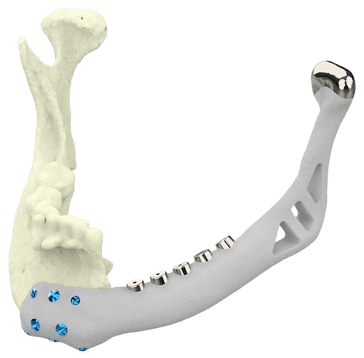
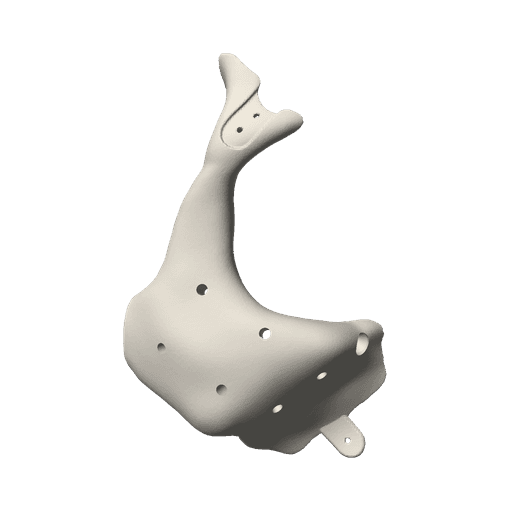
Mandible reconstruction after tumour resection or trauma, with integrated fixation points.
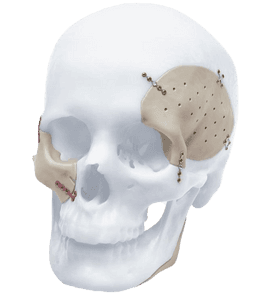
Orbit, zygoma and midface, where the aesthetic result matters as much as the function.
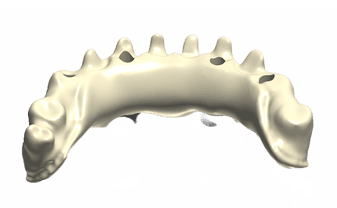
Prosthetic arches and bases machined to measure from the patient's imaging.
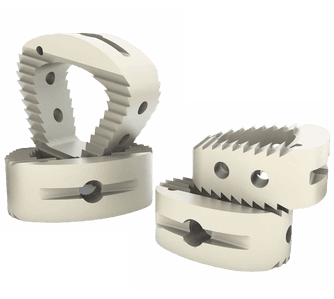
Cervical interbody fusion, in a radiolucent material.
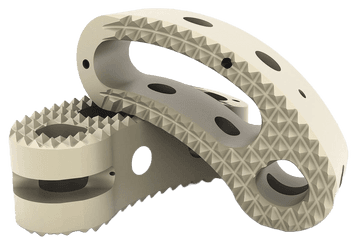
Lumbar interbody fusion, with anti-migration surface.
Depending on the size of the bone being replaced — length, width and height — the implant may be designed as a single piece or several.
Your surgeon has sent us your scan. Here, without the jargon, is what you should know about the piece that will replace the missing bone.
A technical plastic called PEEK — specifically PEEK-OPTIMA™ Natural, a polymer used in implant surgery for decades. It is neither a metal nor a material that dissolves inside the body.
PEEK is biocompatible: the risk of inflammation or rejection is very low. Its stiffness is close to that of bone, so it moves with your skeleton rather than resisting it.
Barely. PEEK is radiolucent: your CT and MRI images stay readable, without the interference metal implants cause. That is a real advantage for follow-up.
The implant is light and drawn onto your own anatomy, from your own scan. That is precisely what makes an aesthetic result true to your original shape possible.
The design goes to your surgeon within 72 hours. Once approved, the final implant is delivered to them within 30 days.
COVTECH MEDICAL works only on prescription and under the responsibility of your surgeon. Decisions about your operation are theirs: ask them your questions — they know your case.
Send through your patient's CT slices. We'll come back to you with a design proposal and a firm timeline.
Please don't include patient-identifying data in this form. We'll agree a secure channel together for the DICOM files.
Monday – Friday, 8:30 – 17:30 (GMT+1)
